
Breath in DH
Winnie E. Pérez Martínez’s post on the Scholars’ Lab blog this week got me thinking. In “Breadth and Depth, a Self-Centered Dialectic,” she revisits how we discuss breadth and depth as two approaches to digital humanities professional development. In this framing, one that I have put forward myself, we can think of careers in DH as operating on two axes. On the one, we are expected to know a little about a lot of things. On the other, we are directed more towards narrow, specialist-level knowledge about a smaller subset of methods. Breadth vs. depth. Few careers really ask us to go entirely in both directions. More practically, we tend to specialize in a couple areas within DH and develop passing familiarity with many more.
For me, the dichotomy between breadth and depth was a way to help students map their career plans onto the different skills they might acquire. I thought of it as a way to free yourself from the need to be expert in everything. In her post, Pérez Martínez expertly shows how breadth and depth actually inform and lead to one another. There can be no one right way in. If you start deep, you might find yourself broadening, and starting wide can help you to focus in. What most resonated about Pérez Martínez’s post, though, was the way in which you can see an exceptional scholar and practitioner wrestling over whether they are enough, over whether they could ever develop the necessary skills they need to feel complete. Those anxieties never really go away. I feel them too. I recognized myself in Pérez Martínez’s post, and I couldn’t help but sense that the breadth against depth framing seemed to be having the opposite effect I would want, heightening anxiety rather than mitigating it.
Pérez Martínez proposes a broadening of the axes I had envisioned. Breadth and depth move beyond just X and Y, curling in upon themselves until they start to push outwards. The moment reminded me of the age-old dichotomy of “hack” vs. “yack” in DH work and how Laura Braunstein offered “stack” as an important third term. In addition to coding and technological critique as key parts of DH work, Braunstein’s intervention elevates “the often invisible technological, social, and physical structures within which scholarship is produced and disseminated.” For Braunstein, DH work is more than just the sum of what we do, it also consists of the structures we put in place to enable that work. In the same spirit and inspired by Pérez Martínez, I have been wondering what breadth and depth leave out, what they gesture towards within and beyond the teaching that we do.
Put another way, what is education if not just content? One point of comparison here is L. Dee Fink, whose Taxonomy of Significant Learning illuminates the various components of teaching.
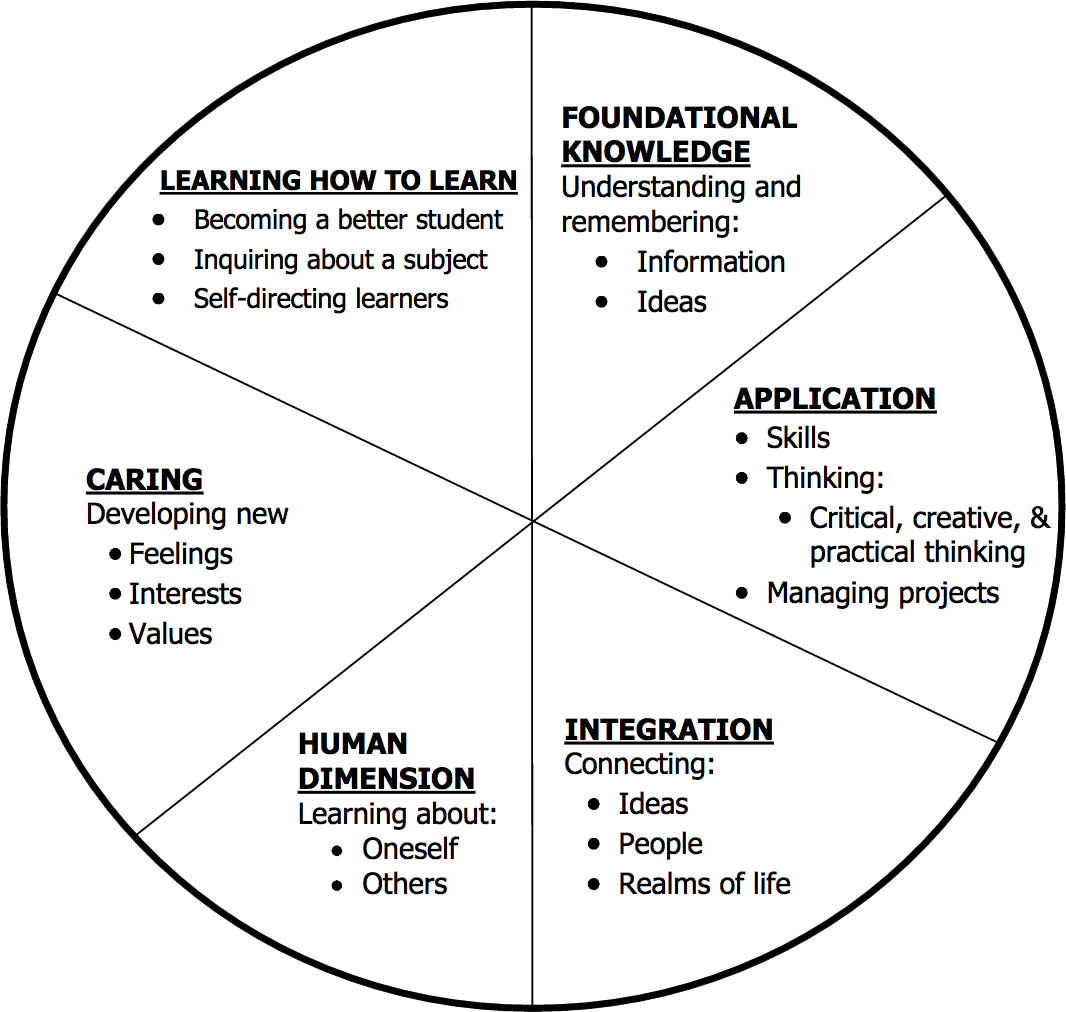
Caption: L. Dee Fink’s Taxonomy of Significant Learning as shared on Florida International University’s Center for the Advancement of Teaching.
Fink’s Taxonomy usefully illustrates all the things that lie beyond the subject matter in the courses we teach. Learning is more than consuming books, articles, or topics. Teaching is more than passing along skills and methods. If we think of DH merely as skill building, we live too much in the upper right of the circle. We leave out the rest of what makes DH experiences—and DH learning—significant for so many of us. We ignore the transformative mentoring that shows a variety of career options. We miss the collaborative practices that can change how we view our work in dialogue with others. We do not account for how true interdisciplinarity changes our perspectives on our own research processes. We need a new term to trouble the dichotomy between breadth and depth that can capture a more capacious view of what it means to practice digital research and teaching, one that goes beyond subject matter, methods, and skills.
I find this particularly urgent in the age of generative AI, a complicated set of technologies that threatens to instrumentalize education beyond recognition. What counts as methodological training if you can vibe code your way to a launched digital project? What counts as digital pedagogy if our students are secretly using chatbots as study partners? How do we make room for conversations about professional development that do not reduce people to a tidy axis of skill acquisitions?
What lies beyond the breadth and depth of what it means to be a digital humanist?
I would introduce a third term for DH professional development: “breath.” Breadth and depth ask us to think about what we can and cannot do, about the subject matter and methods of DH work. The terms ask us to think about the limits of our knowledge and our inability to pursue universal expertise. Breath asks us to reframe the conversation entirely. It is an invitation to pause and re-embed our work in the body. How do we feel about our labor? Who are the working souls in DH and how do we engage with them? How do we work or overwork our own body to the point of breathlessness? What is the lived experience of our labor that transcends the skills or methods? What are the affects—the joys, frustrations, traumas, triumphs—of DH work that cannot be captured by thinking in terms of skill acquisition? How do our energies map onto a living, breathing community of thinkers and doers beyond the work on the table in front of us? Where do we fit in?
Breadth and depth ask students to think about where they could be, professional development by way of spatial orientation. Breath invites students to consider where they are, to think of themselves as real people with real needs that need attending.