
Mapping Queer Belonging
I want to take this first blog post as a chance to write down some reflections prompted by these first months of the Praxis program. Most notably the conversation with Jeremy about the big “why” of Digital Humanities projects in relation to Frank Chimero’s Shape of Design, Zarif’s and Jess’ presentations on poetry and novels, and Drew’s presentation on GIS.
I have been thinking of creating a digital map of Fiore de Henriquez’s (1921- 2004) artworks in their current location. Fiore was an intersex artist and sculptor from Trieste, my hometown, and I have been researching her works as part of my dissertation. While she received commissions from all over the world, the locations of her artworks are largely unknown and not publicised. I have been wondering whether my mapping of her practice should include the artist’s over-the-top stories about her experience of gender difference, as performative acts through which the artist expressed her view of herself and her work. These tales often contain elements of fiction, but they always take place in highly recognisable and memorable places. Thinking about my “why” for this project, and about what it might look like, I was reminded of Queering the Map.
Queering the Map was created by Lucas LaRochelle in 2017, in effort to re-think how queer geographies of space are usually conceived. It anonymously archives queer experience in relation to place via a pink map with black pins, to which anyone in the world can add their own contribution. This collaboration inevitably results in “something that is fundamentally messy, contradictory, and confusing” (LaRochelle, 2019). Some pins are jokes, some are cryptic, some read as reviews of certain locations, others are confessions, personal and heartfelt. Some are tragic and filled with grief.
Repeating a fairly common sentiment, LaRochelle expresses that his “why” was “to contribute to the life-sustaining force that is queer internet culture”, citing his own life-changing experience in digital queer spaces, which made up for the nonexistence of queer places in rural Ontario, where the author grew up. However, I see this map as doing something else. To me, it complicates the narrative of the digital as a place for queer connection when the local is a place of queer solitude and loneliness. Instead, the digital anonymous character of the map makes visible the multiple, contradicting, sometimes imagined ways a place can be queer. It expands the common reduction of queer spaces to bars, clubs and saunas. Instead, it makes visible the multiple, complicated ways any place, no matter how homophobic or transphobic, can be made queer.
Some comments on the map are clearly not interested in recounting real events at all – some pins in the middle of the ocean include comments like “made out with a mermaid :)”. Even for those that seem earnest, there is no guarantee that the pins have been placed in the actual street where the events narrated took place, nor if the events recounted even happened at all.
Reading random pins on this map, I am reminded of Fiore’s way of telling her life stories as half-made-up tales. They also remind me of a poem by Umberto Saba, (1883-1957). Umberto Saba is the only writer from my hometown, Trieste, that is included in high school textbooks around the country. As an Italian irredentist, he’s one of the few writers from the regions that fits the state’s nation-building narrative. I have studied his poems many times, learning them from memory as early as elementary school. But I was never told he was queer, nor that he thematised his experience of queerness in a number of his poems and novels. Here is one of his most famous poems, titled “Trieste”:
| Ho attraversato tutta la città. Poi ho salita un’erta, popolosa in principio, in là deserta, chiusa da un muricciolo: un cantuccio in cui solo siedo; e mi pare che dove esso termina termini la città. Trieste ha una scontrosa grazia. Se piace, è come un ragazzaccio aspro e vorace, con gli occhi azzurri e mani troppo grandi per regalare un fiore; come un amore con gelosia. Da quest’erta ogni chiesa, ogni sua via scopro, se mena all’ingombrata spiaggia, o alla collina cui, sulla sassosa cima, una casa, l’ultima, s’aggrappa. Intorno circola ad ogni cosa un’aria strana, un’aria tormentosa, l’aria natia. La mia città che in ogni parte è viva, ha il cantuccio a me fatto, alla mia vita pensosa e schiva. |
I traversed the entire town. Then I climbed a steep slope, crowded at first, deserted further up, closed by a low wall: a nook where I sit alone; and it seems to me that where it ends the town ends too. Trieste has a surly grace. If one likes it, it is like a rascal, harsh and voracious, with blue eyes and hands too big to offer a flower; like a love with jealousy. Up from this slope every church, any street I discover, whether it takes to the huddled beach, or to the hill where, onto the rocky top, a house, the last one, clings. All around circles all things a strange air, a tormented air, the native air. My town that is in every of its part alive, has a nook made just for me and my life, pensive and reserved. |
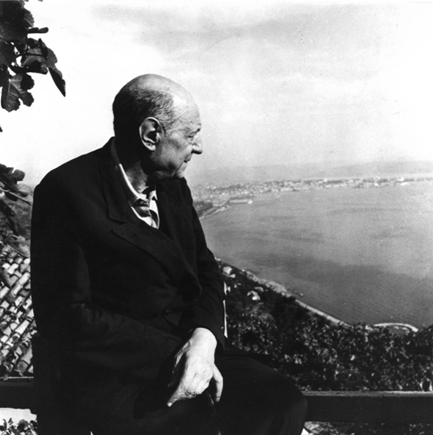
Saba sitting by the bay overlooking Trieste, 1951
In this poem the bird’s eye view on the territory allows the poet to see the city in all its contradictions, both crowded and deserted, teeming with life but with quiet, solitary corners. After the difficult ascent to earn such a perspective, the poet finds within these contradictions a sense of belonging. The strange, tormented air is recognised as denoting home. When I studied this poem in school, this sense of belonging was taught as a general one, but I always felt it was queer, even before knowing of Saba’s sexuality. Specifically, the personification of Trieste as a “ragazzaccio” struck me as significant.
Cities are usually personified as female in art and literature. They are to be defended, and protected, they are the “motherland” of the masculine citizen. At the same time, they are also lovers of the presumed male citizen, and the love for one’s hometown needs to be established as a heterosexual one. This is even more explicit in Italian, where they are grammatically gendered female, as in most romance languages. Here however, Trieste is a boy, and a bad boy at that. He’s sweet but rough, he wants to consume and take – he’s voracious – but is unable to be delicate and give anything back, not even a flower. The city is transitioned into an image of an imperfect boy, who the poet cannot help but love in an imperfect way, with jealousy. The poem is queer because it transitions the city in order to make the love between the poet and the city a queer one. I read it as a queer outlook onto the landscape, one that generates a queer sense of belonging and personal peace. Like in Queering the Map, the view from above reveals the multiple, complex, and contradictory ways the landscape is lived in. Among these is the “cantuccio a me fatto”, a small and hidden but safe place for queerness.
These have been some thoughts inspired by these first few months of class. While I have largely used the case of Trieste to work through some of them, I wonder how they might resonate beyond this case study (and I must thank Eleanor for her comments about how they spoke to her own experience). As I am figuring out what my DH project on Fiore will look like, I will keep thinking about Saba and Queering the Map, and whether the digital, with its ability to reunite at a glance such diversity of experience, can make visible how queerness inhabits unlikely places.
Works cited:
-
Chimero, Frank. The Shape of Design. Frank Chimero, 2012.
-
Co-Creation Studio at MIT Open Documentary. ‘Co-Creating a Map of Queer Experience’. Medium, 2 November 2019. Link
-
Queering The Map. ‘Queering The Map’. Accessed 12 October 2025. Link
Poem Translation:
Literaryjoint. ‘Trieste, by Umberto Saba, English Translation’. LiteraryJoint, 6 March 2013. Link